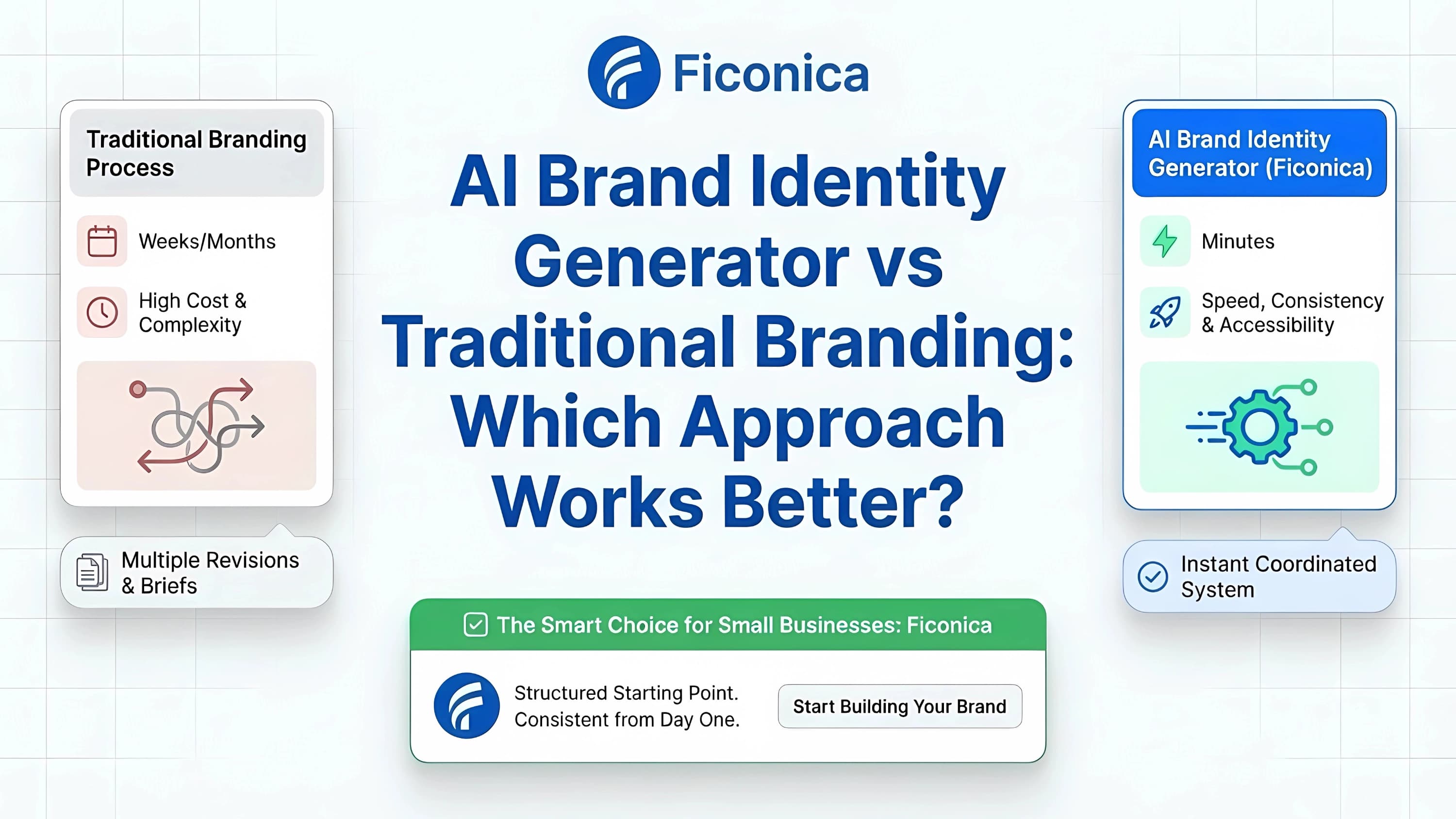
AI Brand Identity Generator vs Traditional Branding: Which Approach Works Better?
Short answer
An AI brand identity generator offers small businesses a faster, more accessible way to create a cohesive brand identity compared to traditional branding, which is more time-consuming and costly but allows for deeper customization.
An AI brand identity generator — sometimes referred to simply as an AI identity generator — has fundamentally changed the way small businesses approach branding. Building a brand identity used to mean working with a designer, going through multiple revision rounds, and spending weeks on decisions. Today, most of those decisions can be made in minutes. So which approach actually works better?
What Does Traditional Branding Involve?
Traditional branding is a process managed by designers or agencies. Logo, color palette, and typography are typically handled in separate stages. Briefings, revisions, and approvals are each treated as individual steps. This extends the overall timeline significantly.
Each stage depends on the one before it. A color palette cannot be finalized until the logo direction is confirmed. Typography choices follow after that. This sequential structure means a complete visual identity can take weeks — sometimes longer — to reach a finished state.
For businesses with large budgets and dedicated teams, this process works well. For small businesses, however, it can create serious barriers in terms of both time and cost.
The investment required — both in time and budget — can delay a brand launch or limit early-stage growth. For many small businesses, getting a professional visual identity off the ground quickly is not a luxury but a necessity.
How Does an AI Brand Identity Generator Work?
An AI brand identity generator brings all branding decisions under one roof, as a complete and coordinated system. All visual decisions — from logo to color system and typography — are generated as a coordinated set. The result is a coordinated brand identity that is ready to use in far less time. In short, an AI identity generator replaces a fragmented, multi-stage process with a single coordinated workflow.
The key difference is structure. Rather than moving through separate stages, an AI brand identity generator handles logo, color palette, and typography within the same workflow — producing a more cohesive visual identity from the start.
Ficonica includes logo and brand-kit tools in one platform. Starting from a few key details about the business and its visual direction, it offers logo options to explore. Available features and usage limits depend on the current plan. It automatically generates a color system and typography. Beyond that, it presents mockup versions of business cards, social media visuals, and corporate identity materials — all within a single platform. Every element can be previewed and adjusted before download — and the entire brand identity can be explored for free before any payment is required.
Where Does Each Approach Have an Advantage?
Traditional branding offers a high degree of creative customization. An experienced designer can translate a brand's story into a distinctive visual language. For businesses where brand differentiation is critical, this approach may be preferred.
The depth of creative input in traditional branding can produce results that are highly tailored to a specific brand vision. This level of customization, however, requires time, budget, and ongoing communication between the business and the design team.
AI-powered branding, on the other hand, excels in speed, consistency, and accessibility. It simplifies the process without compromising visual quality. For small businesses that need a professional brand identity quickly and within a limited budget, it is the more practical choice.
An AI brand identity generator also removes the dependency on external teams. Visual decisions can be made independently, adjusted in real time, and finalized without waiting for revision cycles. For small businesses managing their own brand, this level of control is a practical advantage.
Which One Is Right for Your Business?
For early-stage businesses and startups, the speed and structure offered by an AI-powered approach provide a significant advantage. As the brand grows, traditional branding elements can always be added in.
Ficonica gives small businesses a structured starting point. By bringing logo, color, and typography together on a single platform, it ensures that the brand identity is consistent from day one.
Starting with a complete and consistent visual identity means every future brand decision has a clear reference point to build from.
Conclusion
Choosing between an AI brand identity generator and traditional branding is not about which approach is superior — it is about which one fits your current needs. For small businesses in the early stages, the speed, consistency, and accessibility of AI-powered branding provide a strong foundation to build from.
A complete visual identity — including logo, color palette, and typography — no longer requires weeks of back-and-forth or a large design budget. An AI brand identity generator makes it possible to establish that foundation in minutes.
Ficonica brings this together in a single platform. Logo, color system, and typography are developed within the same workflow — giving any business a professional and consistent visual identity from day one. Every element can be previewed and adjusted before download.
Before purchasing, review Ficonica’s current plans, refund conditions and privacy policy.
Related pages:
AI Brand Identity Generator How Ficonica's AI Brand Kit Generator Works
Frequently asked questions
What is traditional branding?
Traditional branding is a multi-stage process managed by designers or agencies involving separate steps for logo, color palette, and typography, often taking weeks to complete.
How does an AI brand identity generator work?
It generates a coordinated set of visual elements like logo, color palette, and typography within a single workflow, producing a cohesive brand identity quickly.
What are the advantages of traditional branding?
Traditional branding offers a high degree of creative customization and can produce highly tailored visual identities for brands needing strong differentiation.
Why might small businesses prefer AI branding?
AI branding is faster, more consistent, accessible, and cost-effective, allowing small businesses to create professional brand identities without long timelines or large budgets.
Can AI branding and traditional branding be combined?
Yes, small businesses can start with AI-generated brand identities for speed and consistency, then add traditional branding elements as the brand grows.
Recommended Articles
Join Our Newsletter
Join our creative community and stay ahead of the curve with fresh design perspectives.