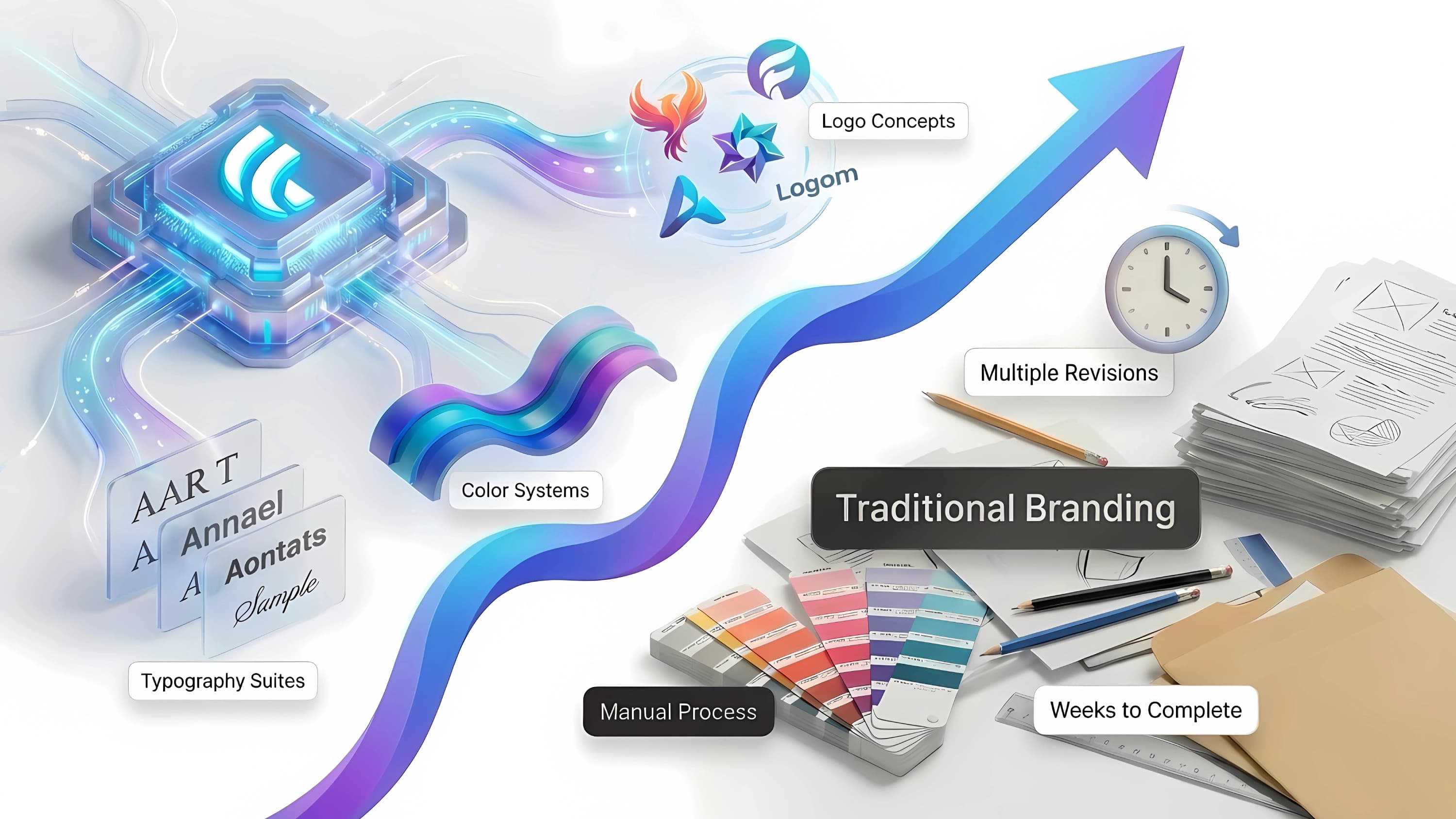
The definition of brand identity is the set of visible brand elements a business uses to present itself consistently - usually including its logo, colors, typography, imagery, and design rules. In simple terms, it is the visual system that helps people recognize a business across a website, social media, packaging, email, and print materials.
That short definition is useful, but it can also be a little too neat. Many business owners hear “brand identity” and assume it means their logo alone. Others use it to mean everything about the business, from marketing strategy to customer service. In practice, brand identity sits in the middle. It is not just a logo, and it is not the entire business. It is the designed expression of the brand.
What is the definition of brand identity in practice?
In practice, brand identity is the coordinated visual language a business uses repeatedly so it looks like the same business everywhere. If your Instagram profile looks modern and minimal, your website uses different fonts, your invoices look generic, and your packaging uses unrelated colors, you do not really have a working brand identity yet. You have separate pieces.
A real brand identity connects those pieces. It gives structure to how your business appears in the world so customers, clients, or followers get a more consistent impression. That consistency does not guarantee trust or sales, but it generally helps a business look more organized and easier to recognize.
For a startup, freelancer, creator, or small business, that often matters more than having a highly complex brand system. Most early-stage businesses do not need a 100-page brand strategy document. They need a usable identity they can apply right away.
What brand identity usually includes
A brand identity usually includes a primary logo, alternate logo variations, a defined color palette, selected fonts, and some basic rules for how those elements should be used. It may also include icon style, image direction, social media templates, business card layouts, email signature styling, and simple brand guidelines.
The exact scope depends on the business. A local service business may only need a logo set, colors, fonts, and a few basic assets. An ecommerce brand may also need packaging visuals, product label rules, and social graphics. A software startup may need presentation templates and app-related brand elements. So the right identity system depends on where the brand actually shows up.
That is why “brand identity” is best understood as a system, not a single file. If all you have is one logo PNG, you have a starting point, not a complete identity.
Brand identity vs branding vs brand image
These terms often get mixed together, and that creates confusion.
Brand identity is what the business creates and controls visually. Branding is the broader process of shaping how the business presents itself through design, messaging, positioning, and customer experience. Brand image is how people actually perceive the business.
That difference matters because a business can create a polished identity and still have weak customer perception if its product, service, or communication falls short. On the other hand, a strong business can look less credible than it should if its visual identity is inconsistent or outdated.
So brand identity is only one part of the bigger picture. It helps express the brand, but it does not replace strategy, marketing, operations, or product quality.
Why small businesses care about brand identity
For large companies, brand identity is often managed by in-house teams or agencies. For small businesses, it is usually more practical than theoretical. You need to know what to put on your website header, what colors to use in social posts, what logo file belongs on a business card, and how to make your materials match.
Without a defined identity, every design choice becomes a new decision. That slows things down and leads to inconsistency. One week you use a bold sans serif font, the next week a script font, then a different shade of blue, then a logo cropped from a screenshot. That kind of patchwork is common when a business is moving fast, but it makes the brand look unfinished.
A usable identity reduces that friction. It gives you a repeatable set of choices so you are not rebuilding the look of the business every time you create something.
What brand identity is not
Brand identity is not your business plan. It is not your slogan unless that slogan is part of a broader brand system. It is not trademark registration, legal ownership, or name clearance. It is also not a marketing performance tool by itself.
This is worth stating clearly because many founders expect visual branding to solve problems that sit elsewhere. A cleaner logo will not fix weak positioning. Better fonts will not correct confusing pricing. A polished brand kit will not automatically improve ad results.
Good identity work can support those areas by making the business appear more coherent and professional. But the results depend on context, execution, and the rest of the business.
What makes a brand identity effective?
An effective brand identity is usually clear, consistent, appropriate for the business, and practical to use. “Appropriate” is important because design quality is not only about taste. A consulting firm, handmade candle shop, fitness coach, and gaming creator may all need very different visual styles.
The best identity for a business is not necessarily the most artistic or original. It is often the one that fits the audience, can be applied across real touchpoints, and still works six months later when the business is producing invoices, social posts, pitch decks, packaging, or signage.
This is also where trade-offs show up. A highly custom identity created by a designer or agency may offer more originality, strategic depth, and nuanced creative direction. An AI-assisted branding platform may be more suitable when speed, affordability, and basic consistency matter most. Neither route is automatically right for everyone.
What small businesses actually need first
If you are launching or cleaning up an inconsistent brand, start with the essentials. You generally need a logo system rather than one logo, a small color palette rather than ten colors, a font pairing you can use consistently, and simple guidelines that explain how to use those assets.
From there, think about the places where customers will actually see your brand. That might include your website, social media profiles, proposal documents, email signature, business cards, and packaging. If an identity element cannot be used easily in those places, it may not be helping much.
This is also why many small businesses look for tools that turn brand decisions into ready-to-use assets. A platform such as Ficonica may help when you need to move from a business name and industry description to a coordinated visual identity without starting with a full agency engagement. That said, a freelancer, designer, or agency may be more appropriate if you need deeper strategy, custom illustration, or a more specialized system.
A simple test for whether you have a brand identity
Ask yourself three questions. Do your brand materials look like they belong to the same business? Could someone else on your team use your colors, fonts, and logo correctly without guessing? Can you apply your brand consistently across digital and print formats?
If the answer is no to most of those, you probably do not have a complete brand identity yet. You may have pieces of one, but not a system.
That is normal, especially for newer businesses. Brand identity often develops in stages. The goal is not perfection on day one. The goal is to create a clear visual foundation that is consistent enough to use now and flexible enough to refine later.
What the definition really means for your business
If you came here asking what is the definition of brand identity, the practical answer is this: it is the visual framework that makes your business look recognizable and coordinated across real-world use. Not just in theory, and not just on a logo file.
The useful next step is not memorizing the term. It is looking at your current brand materials and asking whether they work together as a system. If they do, your identity is doing its job. If they do not, start smaller, make it usable, and build from there.